SAP TRAINING
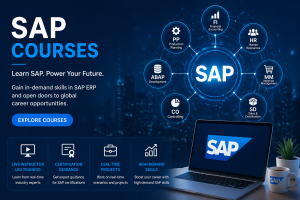
At Solaris Softech, the SAP training program is designed to help students gain knowledge of enterprise resource planning (ERP) systems used by large organizations to manage business operations efficiently. SAP is one of the world’s leading ERP platforms that integrates various business processes such as finance, human resources, sales, and supply chain into a single system. The SAP course at Solaris Softech typically runs for around three months and focuses on providing both theoretical understanding and practical exposure to different SAP modules. (Collegedunia)
The training emphasizes real-time concepts, allowing students to understand how SAP is used in industries for managing data and improving productivity. Learners can explore different modules based on their interests, such as finance (FICO), human resources (HCM), or technical areas like ABAP, helping them build specialized skills. With guidance from experienced trainers and hands-on practice, Solaris Softech prepares students for career opportunities as SAP consultants, analysts, and support professionals, making it a valuable course for those aiming to enter the corporate IT and business management field.
ABOUT SAP:
The main ones are:
FI (Financial Accounting) – Manages financial transactions, accounts, and reporting
CO (Controlling) – Handles cost management and internal reporting
MM (Materials Management) – Deals with procurement and inventory
SD (Sales and Distribution) – Manages sales, orders, and billing
PP (Production Planning) – Handles manufacturing and production processes
HCM (Human Capital Management) – Manages employee data, payroll, and HR processes
QM (Quality Management) – Ensures product quality and compliance
PM (Plant Maintenance) – Maintains equipment and technical systems
WM (Warehouse Management) – Manages warehouse operations and stock placement
ABAP (Advanced Business Application Programming) – SAP’s programming language for development
BASIS – Technical administration of SAP systems
These are the core branches, but SAP has many more specialized modules like CRM, SCM, and BI depending on business needs.
SAP SYLLABUS:
Here is a typical SAP training syllabus in points as offered by institutes like Solaris Softech:
SAP Course Syllabus
1. Introduction to SAP
Overview of SAP and ERP concepts
SAP architecture and landscape
SAP GUI navigation
2. SAP Modules Overview
Introduction to FI, CO, MM, SD, HCM
Understanding integration between modules
3. SAP Financial Accounting (FI)
General Ledger (G/L) Accounting
Accounts Payable & Accounts Receivable
Bank Accounting
Financial statements
4. SAP Controlling (CO)
Cost center accounting
Profit center accounting
Internal orders
Cost element accounting
5. SAP Materials Management (MM)
Procurement process
Purchase requisition and purchase orders
Inventory management
Vendor management
6. SAP Sales and Distribution (SD)
Sales order processing
Pricing and billing
Shipping and delivery
Customer master data
7. SAP Human Capital Management (HCM)
Organizational management
Personnel administration
Payroll processing
Time management
8. SAP Production Planning (PP)
Production process
Bill of Materials (BOM)
Work centers and routing
Production orders
9. SAP ABAP (Basics)
Introduction to ABAP programming
Data types and internal tables
Reports and forms
10. SAP BASIS (Basics)
System administration
User management
Transport management
11. Real-Time Project & Case Studies
End-to-end business process scenarios
Hands-on practice
12. Certification & Interview Preparation
Resume building
Mock interviews
Certification guidance
This syllabus may vary slightly depending on the specific SAP module you choose (like FI, MM, or SD), but this gives a complete overall structure.
At Solaris Softech, the SAP training program is designed to help students gain knowledge of enterprise resource planning (ERP) systems used by large organizations to manage business operations efficiently. SAP is one of the world’s leading ERP platforms that integrates various business processes such as finance, human resources, sales, and supply chain into a single system. The SAP course at Solaris Softech typically runs for around three months and focuses on providing both theoretical understanding and practical exposure to different SAP modules. (Collegedunia)
The training emphasizes real-time concepts, allowing students to understand how SAP is used in industries for managing data and improving productivity. Learners can explore different modules based on their interests, such as finance (FICO), human resources (HCM), or technical areas like ABAP, helping them build specialized skills. With guidance from experienced trainers and hands-on practice, Solaris Softech prepares students for career opportunities as SAP consultants, analysts, and support professionals, making it a valuable course for those aiming to enter the corporate IT and business management field.
ABOUT SAP:
The main ones are:
FI (Financial Accounting) – Manages financial transactions, accounts, and reporting
CO (Controlling) – Handles cost management and internal reporting
MM (Materials Management) – Deals with procurement and inventory
SD (Sales and Distribution) – Manages sales, orders, and billing
PP (Production Planning) – Handles manufacturing and production processes
HCM (Human Capital Management) – Manages employee data, payroll, and HR processes
QM (Quality Management) – Ensures product quality and compliance
PM (Plant Maintenance) – Maintains equipment and technical systems
WM (Warehouse Management) – Manages warehouse operations and stock placement
ABAP (Advanced Business Application Programming) – SAP’s programming language for development
BASIS – Technical administration of SAP systems
These are the core branches, but SAP has many more specialized modules like CRM, SCM, and BI depending on business needs.
SAP SYLLABUS:
Here is a typical SAP training syllabus in points as offered by institutes like Solaris Softech:
SAP Course Syllabus
1. Introduction to SAP
Overview of SAP and ERP concepts
SAP architecture and landscape
SAP GUI navigation
2. SAP Modules Overview
Introduction to FI, CO, MM, SD, HCM
Understanding integration between modules
3. SAP Financial Accounting (FI)
General Ledger (G/L) Accounting
Accounts Payable & Accounts Receivable
Bank Accounting
Financial statements
4. SAP Controlling (CO)
Cost center accounting
Profit center accounting
Internal orders
Cost element accounting
5. SAP Materials Management (MM)
Procurement process
Purchase requisition and purchase orders
Inventory management
Vendor management
6. SAP Sales and Distribution (SD)
Sales order processing
Pricing and billing
Shipping and delivery
Customer master data
7. SAP Human Capital Management (HCM)
Organizational management
Personnel administration
Payroll processing
Time management
8. SAP Production Planning (PP)
Production process
Bill of Materials (BOM)
Work centers and routing
Production orders
9. SAP ABAP (Basics)
Introduction to ABAP programming
Data types and internal tables
Reports and forms
10. SAP BASIS (Basics)
System administration
User management
Transport management
11. Real-Time Project & Case Studies
End-to-end business process scenarios
Hands-on practice
12. Certification & Interview Preparation
Resume building
Mock interviews
Certification guidance
This syllabus may vary slightly depending on the specific SAP module you choose (like FI, MM, or SD), but this gives a complete overall structure.